About Shadow Mountain
An Experimental Artmaking Framework
Shadow Mountain is an experimental artmaking framework focused on examining the systems that shape contemporary militarized environments.
It works at the intersection of art, technology, and place to expose and articulate the paranoia and dominance embedded within systems of state and corporate control, including sensing, surveillance, targeting, and violence. Through this work, Shadow Mountain positions itself as both a research initiative and a creative platform for critically engaging the infrastructures that organize perception, power, and conflict.
Shadow Mountain centers on the places where these systems are built, tested, rehearsed, and deployed, because it is at these sites that their underlying logics become visible and their psychological dimensions take form.
Mission
Shadow Mountain examines systems of militarized sensing, surveillance, targeting, control, and violence, and the technological processes that sustain them, including detection, classification, justification, authorization, and escalation. Shadow Mountain is driven by the belief that these systems are rooted in unresolved paranoia that is continuously reinforced and expanded rather than resolved. The goal is to reveal how these processes function, how they intensify fear, and how they shape the ways in which space, bodies, and movement are understood. We aim to make these invisible mechanisms legible and tangible, while also questioning the assumption that increased technological precision leads to greater understanding or safety.
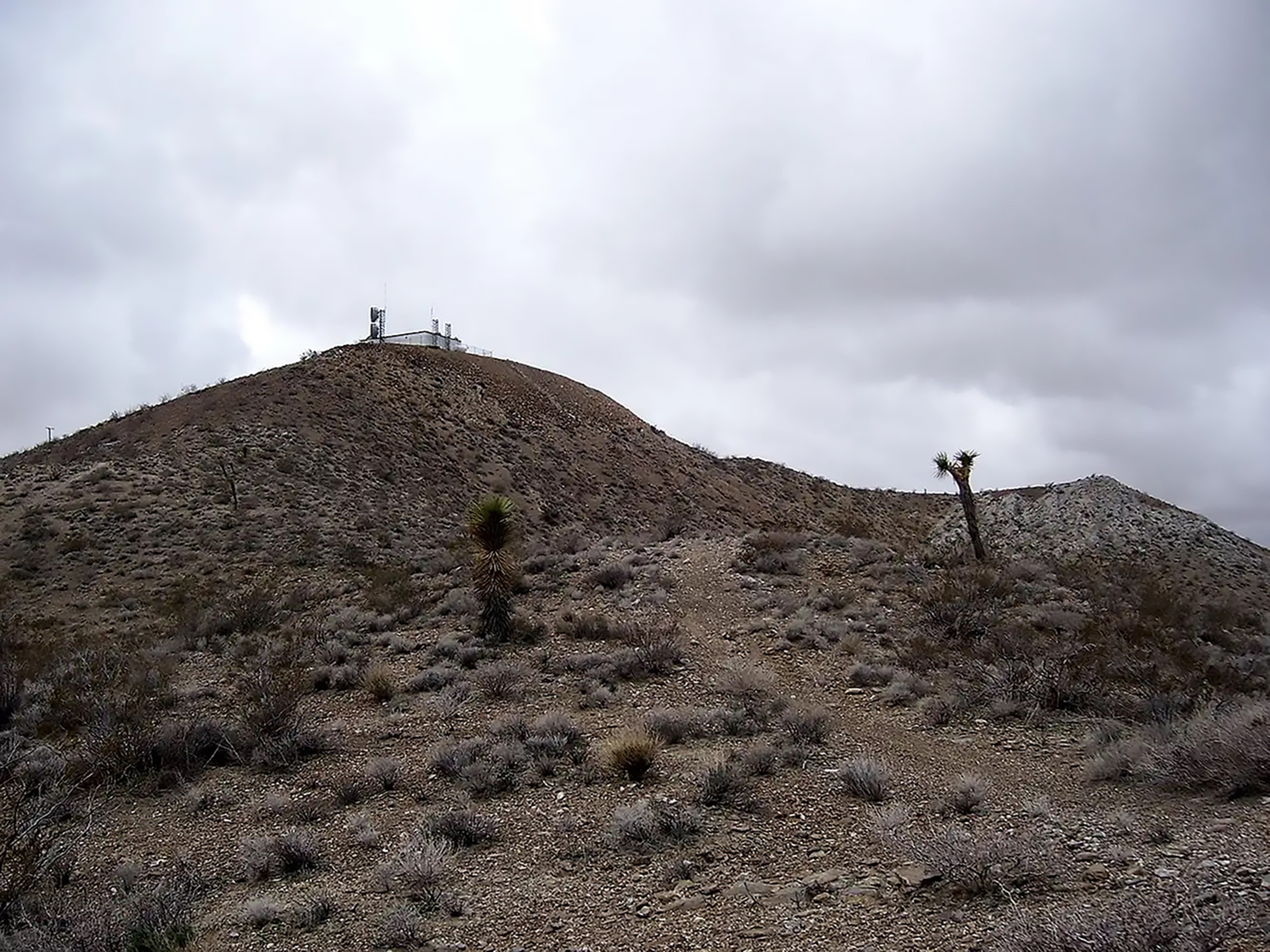
Shadow Mountain works through specific sites, treating place as a primary tool for interpretation. We engage landscapes, aeroscapes, and exoscapes to explore how militarization operates across physical terrain, controlled airspace, and invisible signal environments. Using tools such as radio-frequency receivers, night-vision systems, and remote sensing platforms, we gather and interpret data from these environments, often turning military-derived technologies back onto the systems that produced them.
This work results in a range of artifacts including maps, sculptural works, wireless networks, video installations, and sound works that reveal both the capabilities and limitations of these technologies. We also extend the practice through the Shadow Mountain Hiking Club, bringing audiences to traverse these environments and inviting them to experience, observe, and interpret these systems firsthand.
Technological Engtanglement
Shadow Mountain approaches technology as inseparable from militarization. The systems of militarization do not exist outside of technology; they are produced, organized, and exponentialized through it. Technology is the medium through which militarized systems think, act, and extend themselves across space.
Technologies that validate and enable violence are deeply entangled with those that produce entertainment, visualization, and spectacle. Imaging systems, simulation environments, interfaces, and data processing architectures move fluidly between military and civilian contexts, rarely remaining confined to a single domain. Tools developed for targeting, surveillance, and training are adapted into platforms for media production, gaming, and visual culture, where they are recontextualized but not fundamentally transformed. As they circulate, they carry their underlying logics with them.
Within this overlap, distinctions between observation, representation, and action begin to collapse. Systems designed to detect and classify threats share structural similarities with those used to render immersive environments and visual narratives. Simulation becomes both rehearsal and entertainment. Interfaces developed for command and control become models for interaction and engagement. What appears as spectacle often operates through the same processes that enable control and harm, translating complex environments into manageable and actionable forms.
In this condition, perception itself is shaped through repetition. Ways of seeing are trained, mediated, and reinforced across contexts, linking interpretation to action. The viewer, the operator, and the participant are not entirely separate roles but positions within a shared system of visual and technical logic. Through this convergence, the act of seeing becomes inseparable from the potential to act, binding perception to systems that extend beyond representation and into the organization of force.
Technology Exacerbates State Psychosis & Power
Within militarized systems, technology operates through layered processes that incite and intensify the conditions it is designed to manage. At the most fundamental level, technologies emulate bureaucratic systems of detection, classification, and preemption. Signals, bodies, and behaviors are reduced into simplified forms and categorized. Internal psychosis is externalized as risk. Enemies are imagined, threats are projected, and hierarchies of risk are constructed.
At the next layer, technological systems claim to enhance the fidelity of these threats, making them appear increasingly knowable and actionable. Abstraction becomes justification and authorization. Classification becomes targeting. Analysis becomes a course of action. At the final layers, these systems produce the conditions for superhuman violence, extending the scale, distance, and speed at which force can be applied. Technology does not resolve fear. It intensifies it and builds systems around its persistence.
Technology in Artmaking
Shadow Mountain works through its own technological frameworks as a method of inquiry. Some of the same tools used to sense, classify, and destroy are also used to explore, interpret, and present the work. By engaging these systems directly, Shadow Mountain projects reveal how knowledge is shaped and constrained by the technologies that intermediate it, and how understanding is always conditioned by the tools through which it is formed.
In Creative Inquiry
Shadow Mountain uses technology to explore curiosity within these environments. Tools such as radio-frequency receivers, night-vision systems, and remote sensing platforms are used to engage landscapes, aeroscapes, and exoscapes through partial signals and unstable visibility. These tools are not used to produce complete or authoritative knowledge. Instead, they allow the project to remain within conditions of uncertainty, where noise, fragmentation, and misalignment shape how understanding develops.
In Creative Expression
Technological systems also function as the medium for the work. Data collected in the field is translated into interactive maps, immersive installations, multi-channel video, and sound works that retain the technological conditions of their capture. Technology becomes both subject and form, carrying its own limits and burdens into the work itself. The work is a critique of technology and a participation in its conditions.