
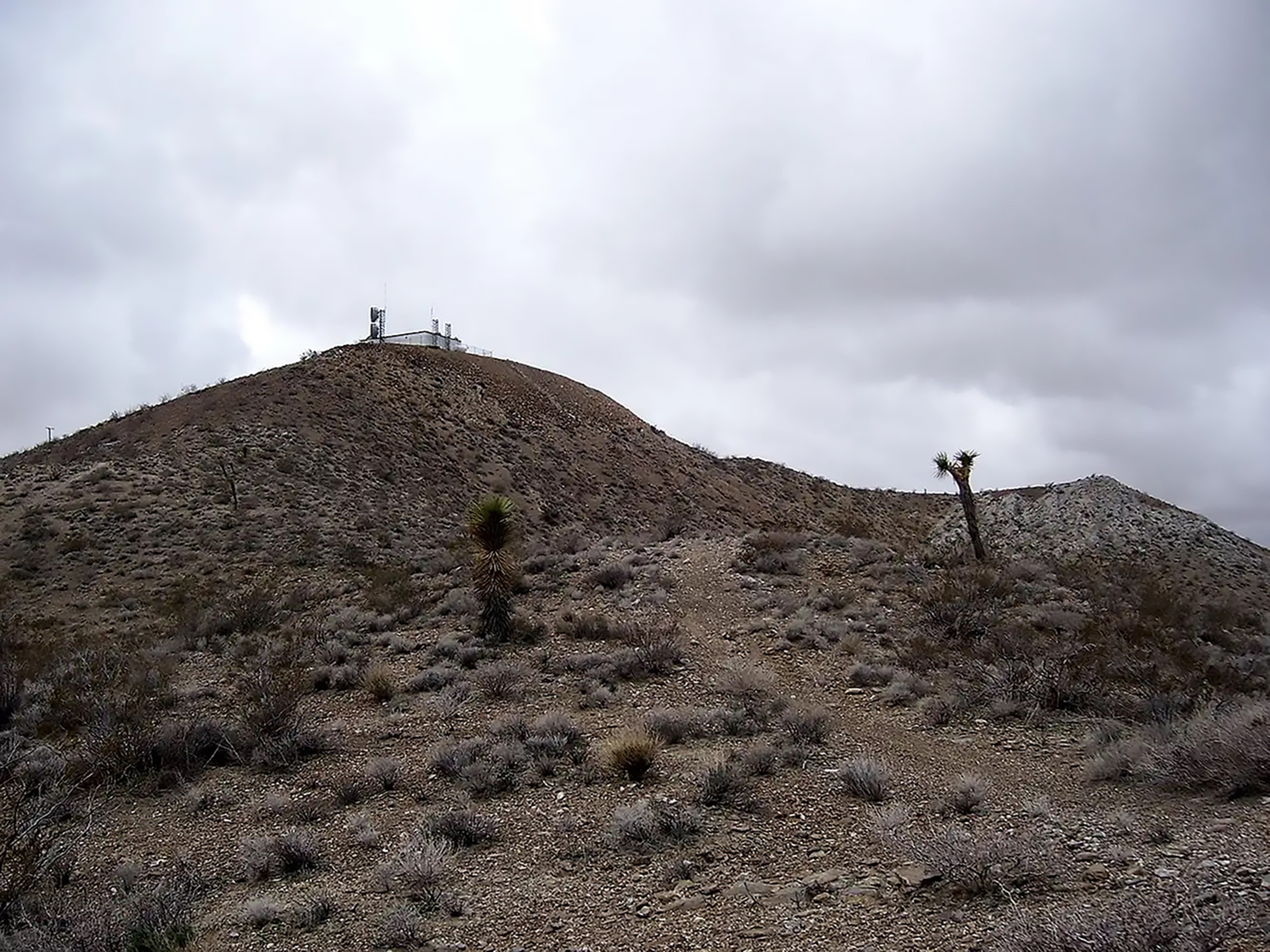
About Shadow Mountain
An Experimental Artmaking Framework
Shadow Mountain is an experimental research and artmaking framework that combines artmaking, technology, and place to expose and articulate the paranoia embedded within systems of state and corporate control. This includes militarized sensing, surveillance, control, and violence, and the technologized processes that magnify them, including detection, classification, justification, authorization, and escalation. Shadow Mountain is motivated by the belief that militarization is rooted in unresolved paranoia that is continuously reinforced and expanded by its own practices.
Sites
Shadow Mountain often works through specific sites, treating place as a primary tool for interpretation. We engage landscapes, aeroscapes, and exoscapes to explore how militarization operates across physical terrain, controlled airspace, and invisible signal environments. The places where militarized systems are built, tested, rehearsed, and deployed can be sites where their underlying logics become visible and their psychological dimensions take form.
Artifacts & Exhibitions
This site interpretationwork results in a range of artifacts including maps, sculptural works, wireless networks, video installations, and sound artworks. We also extend these practices through the Shadow Mountain Hiking Club, bringing audiences to these sites to experience, observe, and interpret these systems firsthand.
Technology, State Psychosis, & Power
Shadow Mountain is especially interested in how technology catalyzes and exacerbates state psychosis and power. Within militarized systems, technology operates through layered processes that incite and intensify the conditions state power is designed to manage.
- At the most fundamental level, technologies emulate bureaucratic systems of detection, classification, and preemption. Signals, bodies, and behaviors are reduced into simplified forms and categorized. Enemies are imagined, threats are projected, and hierarchies of risk are constructed.
- At the next layer, technological systems claim to enhance the fidelity of these threats, making them appear increasingly knowable and actionable. Abstraction becomes justification and authorization. Classification becomes targeting. Analysis becomes a course of action.
- At the final layers, these systems produce the conditions for superhuman violence, extending the scale, distance, and speed at which force can be applied. Technology does not resolve fear. It intensifies it and builds systems around its persistence.
Technology in Artmaking
Shadow Mountain works through its own technological frameworks as a method of inquiry. Some of the same tools used to sense, classify, and destroy are also used to explore, interpret, and present the work. By engaging these systems directly, Shadow Mountain hopes to reveal how knowledge is shaped and constrained by the technologies that intermediate it, and how our understanding is always conditioned by the tools through which it is formed.
In Creative Inquiry
Shadow Mountain uses technology to activate curiosity within the landscapes, aeroscapes, and exoscapes of these sites. Using tools such as radio-frequency receivers, night-vision systems, and remote sensing platforms, Shadow Mountain gathers and interprets data from these environments, often turning military-derived technologies back onto the systems that produced them. Tools such as radio-frequency receivers, night-vision systems, and remote sensing platforms are used to engage through partial signals and unstable visibility. These tools are not used to produce complete or authoritative knowledge. Instead, they allow the project to remain within conditions of uncertainty, where noise, fragmentation, and misalignment shape how understanding develops.
In Creative Expression
Technological systems also function as the medium for the work. Data collected in the field is translated into interactive maps, immersive installations, multi-channel video, and sound works that retain the technological conditions of their capture. Technology becomes both subject and form, carrying its own limits and burdens into the work itself. The work is a critique of technology and a participation in its conditions.
As "Ecstatic Polygraphs"
Shadow Mountain sees technological tools as "ecstatic polygraphs," instruments for recording and exhibiting what cannot be surrounded, stabilized or fully verified. Drawing on Werner Herzog’s concept of ecstatic truth, technology translates human interpretation more deeply when understood as devices that function through incomplete accumulation, misalignment, and narrrow interpretation. There is no resolution that becomes factual. Ecstatic signals are partial. Ecstatic observations are contingent. Ecstatic perception is muffled and blurred. As polygraphs, or machines for recording ecstatic truth, our equipment tries to articulate the incomplete, nuanced, and unstable conditions of perception and the ever-undulating conditions of human uncertainty.